On
this blog we generally try, with any given film, not to attempt to unravel more
than maybe one half of one percent of the issues and questions that the film
may raise. This restriction sometimes
hurts, especially with a picture like Notes on a Scandal that could
probably support a 150 page essay on its own.
This motion picture is so meticulously planned, so well storyboarded,
and so unusually rich both visually and verbally that it’s painful to pick and
choose. (Of course, it’s also incoherent
and preposterous in places. So be
it.) Here I’d like to rope off two
different scenes that feature the same exact surprising revelation about a
character. One comes quite early on in
the picture, the other much later. Let’s
get some background.


Sheba
Hart (Cate Blanchett is well cast in the role, especially in the way her
habitually loose, floppy clothes hang off her tall, lanky body; “Bash” to her
husband) is new to teaching, beginning her first year in the art department at
St. George’s School. In her thirties,
she’s begun a scandalous forbidden affair with her fifteen year old student
Connolly (Andrew Simpson). In the early
scene I’d like to glance at here a much older, psychotic, delusional veteran
teacher named Barbara Covett (Judi Dench does what she can with the hopeless
role) finds out about the affair; in the later scene her much older husband
Richard (the great actor Bill Nighy in a sensational performance) finds
out.
Barbara
is a lonely, bitter, misanthropic woman.
Her diary musings, given to us in great supply throughout the movie via
voiceover narration, show her to be vain, condescending, manipulative, hateful,
sneering, and a predator. (We learn at
the very end that a teacher, now gone, with whom she had a friendship –
Jennifer Dodd – actually hit her with a restraining order.) She is immediately taken with Sheba and
watches her closely from a distance, making endless comments in her diary. (In fact one of her diary entries opens the
film – she remarks that her diary is the only thing to whom she trusts her
secrets!)


Barbara
sees Sheba
as “the wispy novice” who is “artfully disheveled” and that “they flock to her,
even limp little Brian” (Brian being a meek, shy teacher who will play a key
role later). Of Richard, he’s a
“crumbling patriarch”. Their Down’s
Syndrome child is a “court jester”. When
the family does some (admittedly trippy) dancing after dinner, this is
“Bourgeoisie Bohemia.” Yet, her sarcasm and rapier hate also betray
an understanding of people born of deep and long experience – at coffee, when a
fellow teacher remarks to Sheba and Barbara, “I’ve got an announcement,”
Barbara says “You’re leaving St. George’s” and when the teacher says no, she
then offers “Oh, then you’re pregnant,” which is correct. She’s obviously seen the scene many times
before.
Barbara
and Sheba
first meet when the younger teacher is unable to stop a fight that breaks out
in class between Connolly and Davis; Barbara rushes in to help. She remarks that the boys are “little towers
of testosterone”. The incident gives her
an opportunity to establish a beachhead with Sheba, a foundation for a
friendship whose motives, we suspect, are not entirely sane or healthy.
Here’s
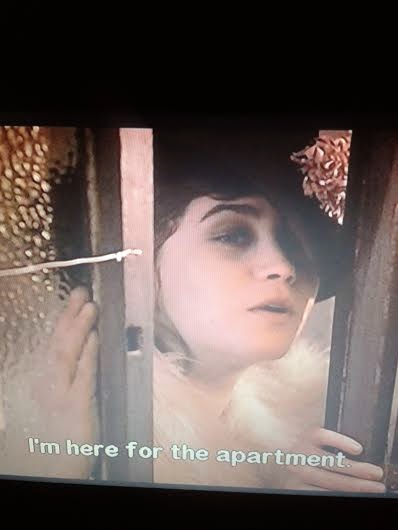
how she finds out about Sheba
and young Connolly- Sheba doesn’t show up for the
school Christmas concert, so Barbara goes searching for her. Seeing the lights on (it’s evening) in the
art room, she proceeds to investigate. Of course she finds her – through a
window she’s able to clearly see Sheba and Connolly having sex
inside. (In fact, the sighting is way
too easy, which is a flaw in the film.
Anyone could have happened by and spotted the wrongdoing.)


By
this point we’ve gotten the feeling that Barbara is tough as nails and that
very little in going to surprise or shock her, which makes the end of this
scene remarkable. The faces of the two
women are caught in expressions that achieve what I’m tempted to call a kind of
cinematic miracle. Dench, Blanchett,
director Richard Eyre and cinematographer Chris Menges all team up to create
something extraordinarily powerful. As
Connolly sneaks away, Sheba
has a kind of joyous naughty girl expression on her face that is worth twenty
pages of dialogue. Similarly, as
Connolly comes out of the building and walks off, Barbara looks after him with
a stare of incredulity that is absolutely priceless. Right here – in just this one clip of film –
the movie justifies itself as a piece of cinematic art many times over.
After
cutting to Barbara, shell shocked, alone, in her apartment later that same
night Eyre cuts quickly to Sheba
in a supermarket parking lot with her mentally disabled boy, moving their
groceries from the shopping cart to their vehicle. Barbara calls her. The comparison of the shots of the two women
on the phone with each other is instructive – the older, alone, in her tidy
apartment, holding the cordless phone in her hand exactly as well she might
have done with a cordless rotary phone fifty years ago, the younger, with her
child, balancing the cell phone on her shoulder, multi tasking.
Caught
red handed, Sheba
can do nothing but agree to a meeting.
Eyre’s
style here is very classically oriented – straight cuts, plenty of shot-reverse
shot technique, commentative music (a score with no percussion by Phillip Glass
that sets the mood). As Barbara
questions Sheba about the
affair Sheba
opens up in a way that she will not when, later, her husband finds out about
the dalliance in a much more explosive scene.
(Keep in mind that Barbara has her own ulterior motives, selfish and
personal, that I’m not getting into here with any depth –she manipulates the
situation to her advantage, to suit her own purposes. Sheba
explains that Connolly came to her seeking help with his drawing (as it turns
out almost everything of importance that Connolly tells Sheba turns out
to be a calculating lie) and that one thing led to another. She says it was “innocent”. (Interestingly enough, later, when she is
trying to explain it all to her husband, she claims the reverse.) She sends him away but he “refused to accept
it” and kept coming back.

But
here’s the rub – she tells Barbara that it began to feel like their secret, and
secrets are seductive. While she knew it
was all wrong, she says she began to feel “entitled”. It asked her, Why shouldn’t you be bad? You’ve earned the right (by being a good
wife, loving mother, etc.) – why shouldn’t you transgress a little? And so the bad girl impulse that we glimpsed
on her face a little earlier comes around full circle.
And
yet later, when she has the opportunity to explain the affair to her husband,
all she can do is stammer that she doesn’t know why she did it. We can have a field day with this, of course,
and all the circumstances are not identical.
For example, Barbara found out about the affair entirely on her own, by
being a peeping Tom, whereas Richard finds out because Connolly’s mother bursts
into the house and throws Sheba a beating (in turn, she has found out about the affair through the grapevine – Barbara planted
the rumor with the whiney, wimpy Brian a few days before and waited for it to
spread).
This
film, as I say, is very rich and abnormally well planned. Very careful attention has to be paid in
order to catch numerous slices of important dialogue and critical visual
information. Too, a lot of the
supporting players are very strong – I have to conclude that Eyre is very
strong with actors. Phil Davis, Michael Maloney,
Stephen Kennedy and Derbhle Crotty are all superb. Bill Nighy absolutely steals the
picture. (Watch the scene in which
Barbara is trying to get Sheba
to come to the vet with her while Sheba’s family is waiting for her
in the car, to go to Ben’s play!) I
guess what stimulates me to include it here is the different ways Sheba reacts to
Barbara’s and to Richard’s learning of her taboo affair. As an overall example of the various
departments of the cinema it ain’t too bad, either.

 I tend to watch a lot of French films, so I guess it’s fitting that I should take up two Hollywood mainstreamers in a row with a marginal connection to France – Papillon here and The Day of the Jackal next. (Coincidentally, these two films share another characteristic which is quite the opposite of the Hollywood norm - there is no love interest in either.) Or maybe not. Nobody is going to confuse Franklin J. Schaffner with Truffaut, Godard, or Varda.
Still, even though Papillon has got to be one of the sloppiest major studio releases ever made, it has enormous power, power that is heightened and intensified by the fact that Henri Charriere really did escape from Devil’s Island and lived to tell the tale. It’s a good thing that Schaffner had enormous facility with this kind of picture because the mistakes in the movie border on the incredible – liquids, both blood and water, quite visibly splash on the camera lens and completely destroy all suspension of disbelief. The guillotine scene is unintentionally hilarious, with continuity and editing goofs that make you wonder if the crew was stoned both during filming and in post production; and the penultimate scene in which Papillon dives into the ocean and we can clearly see the diver supporting the float beneath him – so readily discernible that he or she could almost be a part of the story – these are all truly debauched and unworthy. (There are, in fact, more mistakes, easily Googled. I don’t have the heart to go through everything. One involves the great actor Anthony Zerbe in the role of the leader of the leper colony.)
I tend to watch a lot of French films, so I guess it’s fitting that I should take up two Hollywood mainstreamers in a row with a marginal connection to France – Papillon here and The Day of the Jackal next. (Coincidentally, these two films share another characteristic which is quite the opposite of the Hollywood norm - there is no love interest in either.) Or maybe not. Nobody is going to confuse Franklin J. Schaffner with Truffaut, Godard, or Varda.
Still, even though Papillon has got to be one of the sloppiest major studio releases ever made, it has enormous power, power that is heightened and intensified by the fact that Henri Charriere really did escape from Devil’s Island and lived to tell the tale. It’s a good thing that Schaffner had enormous facility with this kind of picture because the mistakes in the movie border on the incredible – liquids, both blood and water, quite visibly splash on the camera lens and completely destroy all suspension of disbelief. The guillotine scene is unintentionally hilarious, with continuity and editing goofs that make you wonder if the crew was stoned both during filming and in post production; and the penultimate scene in which Papillon dives into the ocean and we can clearly see the diver supporting the float beneath him – so readily discernible that he or she could almost be a part of the story – these are all truly debauched and unworthy. (There are, in fact, more mistakes, easily Googled. I don’t have the heart to go through everything. One involves the great actor Anthony Zerbe in the role of the leader of the leper colony.)


 Whatever; here I want to talk about one small stretch of this long movie, and that’s the closing credits, which compromise not quite a full two minutes. This sequence almost makes me think that Schaffner actually planned a lot of the errors in order to have them work in concert with the credits at the end as a kind of reflexitivity. As Papillon floats in the ocean on his makeshift raft after his daring jump from the cliffs, a narrator heretofore absent is mailed in from the universe to inform us that he escaped, lived the rest of his life in freedom, and outlived the notorious French penal colony. It isn’t clear to me what the advantage is of having a narrator bash in as an uninvited guest like this, and putting the message in text on the screen would have been just as intrusive and distracting. Perhaps Schaffner felt the point was too difficult to get across with more scenes in a “show, don’t tell” kind of way. Perhaps more scenes would have made a long movie even longer, and thus a little less commercially viable. Whatever the case, I think the consistent breaking off of the suspension of disbelief, whether intentional or not, sets up the images that accompany the credits in the end in a new and different way because watching the end credits becomes a necessary part of understanding the movie.
I’ve often wondered what percentage of an audience actually sits and watches the final credits without popping the disc out or leaving the theater. It must be very low, and that’s because a definitive conclusion to the film has usually already been shown on the screen. Nobody cares who the gaffer or the third assistant director is. But here, as we watch the images of the abandoned prison – empty buildings eroded by time and covered in unsupervised vegetation – the enormity of the task that Papillon undertook, his quest for freedom, grows larger and larger in our minds. How many of us could match his zeal? The number is probably smaller than the number of us who sit through the closing credits.
Whatever; here I want to talk about one small stretch of this long movie, and that’s the closing credits, which compromise not quite a full two minutes. This sequence almost makes me think that Schaffner actually planned a lot of the errors in order to have them work in concert with the credits at the end as a kind of reflexitivity. As Papillon floats in the ocean on his makeshift raft after his daring jump from the cliffs, a narrator heretofore absent is mailed in from the universe to inform us that he escaped, lived the rest of his life in freedom, and outlived the notorious French penal colony. It isn’t clear to me what the advantage is of having a narrator bash in as an uninvited guest like this, and putting the message in text on the screen would have been just as intrusive and distracting. Perhaps Schaffner felt the point was too difficult to get across with more scenes in a “show, don’t tell” kind of way. Perhaps more scenes would have made a long movie even longer, and thus a little less commercially viable. Whatever the case, I think the consistent breaking off of the suspension of disbelief, whether intentional or not, sets up the images that accompany the credits in the end in a new and different way because watching the end credits becomes a necessary part of understanding the movie.
I’ve often wondered what percentage of an audience actually sits and watches the final credits without popping the disc out or leaving the theater. It must be very low, and that’s because a definitive conclusion to the film has usually already been shown on the screen. Nobody cares who the gaffer or the third assistant director is. But here, as we watch the images of the abandoned prison – empty buildings eroded by time and covered in unsupervised vegetation – the enormity of the task that Papillon undertook, his quest for freedom, grows larger and larger in our minds. How many of us could match his zeal? The number is probably smaller than the number of us who sit through the closing credits.


 This is a film full of action and violence, which necessarily makes for graphic scenes. But Schaffner also has an eye for the type of more understated, nuanced scene that a lesser director wouldn’t think of lining up. For example, in a scene showing the yard of the notorious prison the camera starts on a small lizard sitting atop the blazing hot roof of the building. A scene depicting a butterfly hunt pays significant attention to the fluttering insects trying to avoid the nets. In a scene in which the prisoners first arrive on the island a hog is shown happily rolling in the mud in the bottom left of the screen. And so on.
But the final scenes that I want to draw attention to here are devoid of people and animals and only show the various parts of the decrepit prison as backdrop for the names of everyone involved in the making of the film while haunting music by Schaffner’s habitual composer, Jerry Goldsmith, builds to crescendo. The end effect upon us is, of course, contemplation of the nature of time. Time, we are being told by these pictures and the music in accompaniment, destroys everything. Sometimes the force of a human will – Papillon’s in this case – can combat it, or stall it off, but in the end the result is always a victory for time. And let’s not forget the cross breeding of the film and the meta-film, which is, overall, one of the most interesting features of Papillon.
This is a film full of action and violence, which necessarily makes for graphic scenes. But Schaffner also has an eye for the type of more understated, nuanced scene that a lesser director wouldn’t think of lining up. For example, in a scene showing the yard of the notorious prison the camera starts on a small lizard sitting atop the blazing hot roof of the building. A scene depicting a butterfly hunt pays significant attention to the fluttering insects trying to avoid the nets. In a scene in which the prisoners first arrive on the island a hog is shown happily rolling in the mud in the bottom left of the screen. And so on.
But the final scenes that I want to draw attention to here are devoid of people and animals and only show the various parts of the decrepit prison as backdrop for the names of everyone involved in the making of the film while haunting music by Schaffner’s habitual composer, Jerry Goldsmith, builds to crescendo. The end effect upon us is, of course, contemplation of the nature of time. Time, we are being told by these pictures and the music in accompaniment, destroys everything. Sometimes the force of a human will – Papillon’s in this case – can combat it, or stall it off, but in the end the result is always a victory for time. And let’s not forget the cross breeding of the film and the meta-film, which is, overall, one of the most interesting features of Papillon.